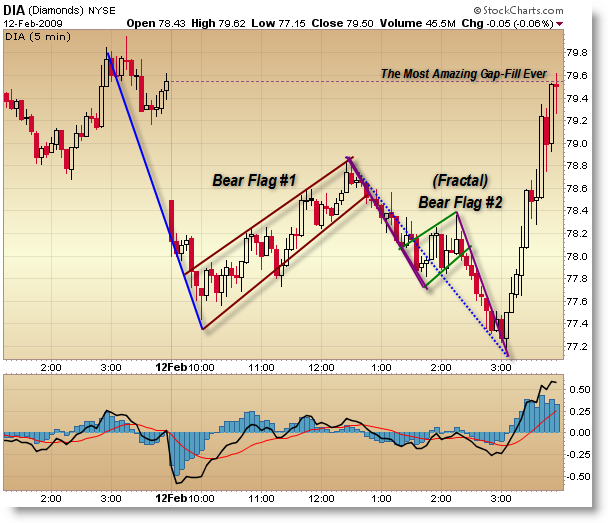
 Bear Flags
My observation of a Bear flag is technically confirmed when you assess the following: A bear flag is consistent with an incisive, strong volume reduction on the basis of negative fundamental occurrence and then a number of sideways movements to a higher price with much weaker volume. This is preceded by a second sharp decline to new lows on solid volume.
Why Does It Happen?
Bear flags are a favored amongst proficient traders since they largely conduct large and self-assertive price movements. Similar to other continuation patterns, bear flags symbolize little more than a fleeting pause in a stronger move lower. The flag form basically forms in the middle of a critical move lower. As with Bull flags, Bear flags occur as stocks seldom move in one direction for any length of time. Instead the movement in cost is interrupted by concise periods of time where investors reassess their positions.
These moments in time are described as flags or pennants. The first section of the bear flag pattern is often described as a flagpole or mast. Throughout this period the stock price deteriorates and falls to a reaction low - usually after some negative fundamental occasion. Quite often this will be a downgrade in guidance, poor production reports or negative earning results. The reaction causes some panic and disappointment; the traders quickly show their dismay and unload their positions, the stock dives rapidly lower. Experienced traders familiar with the stock might have shorted it, other traders are long and as the price falls they have to cover their positions pushing the price even lower. Speculators buy the stock in the belief of a quick turn around, so there could be willing buyers but they usually lose money in these conditions.
It is at this stage the next phase or flag section unfolds. Due to the influx of data and the negative market opinion almost of the stock that was purchased by speculators is vigorously absorbed by nervous sellers but as it unfolds over time the selling pressure subsides and the stock slowly starts to rise with limited volume. The opportunists push the share price higher, although with diluted volume the rally fades and the stock reaches a short term top.
Amidst widespread bearish sentiment the stock charge deterioration threatens to direct the stock lower to new lows. As the losses start, the volume is weak and the share price is supported by bargain hunters. As a result, the prices stabilize and a second short term bottom is established. The second bottom is at somewhat higher levels.
Encouraged by the situation, the stock failed to make a new low. The speculators are preying on the stock and buying into the market. At this time the stock rallies just above but the volume is exhausted and the rally soon dissipates. Over the next few sessions the stock trades in a narrow range consolidating as volume declines hurriedly, before long the stock descends towards the established lows at.
During the next few sessions the stock breaks through the supporting low, this causes a breakout to the downside. A number of analysts report negatively to the market, usually about earnings over the next trading session and a new stage lower commences. The next trading session opens with further losses and the stock trades substantially lower in the coming weeks.
Technical signals
1. Sharp Move: for a continuation pattern to be considered, it requires supporting evidence of a prior trend. These flags necessitate a sharp advance or decline on strong volume. These movements can involve GAPS and are based on solid volume. Although this is generally the first leg of a key ascent or descent it is simply a pause.
2. Flagpole: The flagpole is the distance between the first resistance and the support break until the high or low of the flag. The intense advance or decline that forms the flagpole will generally break a trend line or support or else a resistance level. A line increasing up to the high of the flag creates the flagpole.
3. Flag: the flag is described by the small rectangle pattern that declines towards the previous trend. If the previous move was up then the flag would face down. If the move was down the flag would face up. As the flags are generally short in time, they usually have reaction highs and lows. The share price should be contained between two parallel trend lines.
4. Period: Flags are simply short term patterns and they largely last more or less 1 to 12 weeks.
5. Break: With a bearish flag, a break of the support level indicates that the previous falls have recommenced.
6. Volume: Volume need generally be solid throughout an advance or descent in which it forms a flagpole. The strong volume substantiates its position for a sharp and reactive move that forms the flagpole. The growing in volume at the sustain level provides the confidence in the constitution and the chances of the follow on.
7. Targets: the flagpole length can be determined by the endorse or resistor break of the flag to assess the advance or the decline.


No comments:
Post a Comment