Tuesday, July 27, 2010

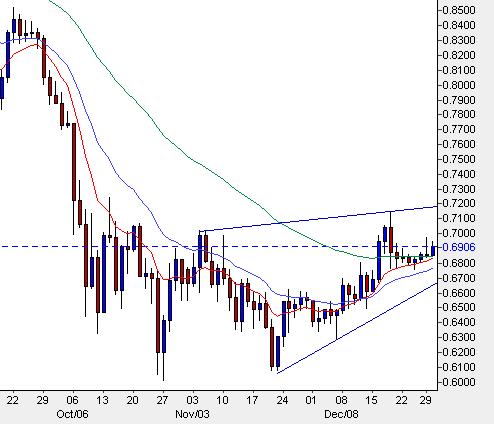
Facts About Growing Wedge

My outlook of a growing wedge is technically confirmed whenever you assess the following: The robust volume, and over a number of weeks, it is a contracting range-bound trade. You will observe the higher highs and higher lows along with slowing volume. Usually what happens next is a different break lower on solid volume.

Why Does It Happen?
As with most reversal patterns a rising wedge scenario is no different. You have an up movement rally that at first observation appears to be in an upward direction with a series of higher highs and lower highs. The flow of information from the media is collectively encouraging. The research houses are out there raising their forecasts for the stock; this includes the share price, earnings and 12 month targets. What is really happening is that the stock is being sold off to the retail investor. The experienced and institutional traders are selling off to the inexperienced mum and dad investors, the less astute or short term speculator. This is all about manipulation and deception.

The pattern embarks on a high profile or sentimental stock; it rises to a new high and proceeds upwards after strong volume. Trend trading and the exhilaration contribute to the rise in the surging share price. On the face of it the fundamental outlook appears solid.

As the share price rises to a new high, uncharacteristically the volume retracts and the share prices decline rapidly to a reaction low. The media and research analysts say us the stock is just taking a breather; they defend the sell off by requiting the long term advance. They restate their buy ratings once more. Then again the share price rises to an all time high BUT the volume deteriorates and the price begins to weaken. It is simple to comprehend at face value the bullish sentiment when the company raises its guidance, wins lucrative contracts, develops new products and good media attention.

Accordingly, underlying manipulation is being carried out as the experience traders and long term investors sell their positions, they distribute their holdings on every good piece of information in the media - while the share price reacts to the downside. The low is higher than the previous reaction low and forms the appearance of a wedge on the chart. Then after a number of sessions of consolidation more good news is released by the analysts and new wires. The share price again rallies to a new high.

During the preceding two rallies the volume is reduced which caused the share price to rapidly begin to weaken. Those same analysts who previously reported on the stock again remain resilient as there is no fundamental occurrence to account for the weakness.

Again research houses reiterate their buy ratings, advising clients to buy and build on weakness. While the longer term experienced traders /investors are selling into the market.

By this time the new advice has no result and the cost declines rapidly. The media and research houses again promote their advice but to no avail. Before long the wedge pattern structures are breached

Almost immediately after, the support at the reaction level is violated. What happens next is the news is quite negative and the inexperienced traders, the speculators and up-to-date investors panic, the price plummets. After several weeks the stock is trading back at its intermediate level of resistance.

Sunday, July 25, 2010

Alternatives Investing Related Information - How to Use the Fibonacci Technique in Foreign Exchange

The Forex trading current market is actually large and frequently intimidating to newcomers, that is why we are here. We have many years of knowledge investing currencies and have tried virtually each and every on the internet plan there is. It can be problematic.
They often don't work at all.
The foreign currency current market is such a dynamic complex system with so numerous variables at play it would be foolish to rely exclusively on 1 method to predict price tag adjustments.

When we very first started currency trading we had been just like you, a little lost with all the choices obtainable, we weren't certain where to turn, each and every broker says they offer you competitive kernel spreads, each training course claims to be the most in-depth, each and every method support claims to be ready to make you cash.

Find an investing system or technique that incorporates as many components and variables as feasible, do lots of investigation, information mining and plenty of excellent old tough operate.

Fibonacci retracements and extensions technique is very a well-known Forex trading dealing technique. Sadly, several traders lack the understanding of how and why the Fibonacci ranges perform and even more traders don't recognize how to use these amounts. Simply because it has everything about Fibonacci - from the history of the technique to the Fibonacci junction explanation to the cease-reduction recommendations when making use of Fibonacci amounts.
Leonardo Fibonacci is a popular Italian mathematician, founder of an easy sequence of amounts that refer to ratios valid for normal proportions of points on the planet.
These ratios appear from the upcoming quantities: 0, 1, 1, 2, 3, 5, 8, and 13 1, 34, 55, 89, 144, 233... And found while performing next calculations: 1+2=3, 2+3=5, and 3+5=8 etc.
If to measure the ratio of any number to one of the next higher number the result will be 0.618. For example, 13/34 = 0.382.
Fibonacci Retracement Levels are used as support and resistance levels: 0.236, 0.382, 0.500, 0.618, and 0.764. 0.382, 0.500 and 0.618) - are the most important to watch for.
Fibonacci Extension Levels are used as targets for taking profit: 0.382, 0.500, 0.618, 1.000, 1.382, 1.500, and 1.618.
The target profit is 0.618, 1.000, and 1.618 at the Fibonacci Levels.

The Golden Percentage
Right after the initial couple of quantities in the Fibonacci sequence, the proportion of any quantity to the following greater quantity is around.
618 and the lower amount is 1.618.
These two figures are the golden mean or the golden percentage.

In Fibonacci Amounts sequence, if we carry the percentage of two successive quantities in the Fibonacci series (that is, we divide each and every variety by the number soon after it in the sequence) we will gravitate towards a specific continuous worth.
That benefit is 0.6180345 which has been referred to as "the Golden Ratio".
If you also calculate the ratios utilizing alternate quantities in the Fibonacci series (that is, do the very same calculation but skip above a quantity) the resulting ratios approaches 0.38196.

Fibonacci Guides Quit Reduction Ranges
a trader can use Fibonacci quantities to established quit reduction orders.

Fibonacci Guides Position Dimension
Depending on the threat you are prepared to consider per trade, Fibonacci quantities can also define placement size.

Fibonacci Guides Objective Setting
making use of Fibonacci figures, after a pattern competes against a Fibonacci established price zone you can make use of these details to fixed profit objectives to salvage partial profits or re-adjust quit burning ranges.
Fibonacci discovered that a string of amounts and their ratios to every other occurred all through nature and in truth are extremely commonplace in the globe.

Friday, July 23, 2010

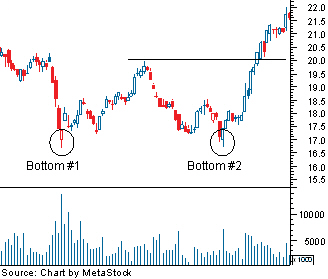
The Principles of Double Bottom for PMP Limited (PMP)

PMP Limited endured a doubling bottom. The technical share price target is calculated by using the following calculation. On the double bottom shaping you begin by adding the change between the first bottom (B1) and the reaction high. Following the second bottom, the recent reaction high is the new breakout point. It is important to be aware that for a double bottom to be confirmed the stock price must break through the reaction high and beyond.

Technical Signals

1. Prior Trend: same further reversal patterns, there must be a movement present to reverse.

2. First Trough: The first trough should symbolize the lowest point of the present trend. The first trough is clearly in a down trend and normal in its development.

3. Peak: next the opening trough a bounce occurs and an answer high is created. Usually it is between 10 and 20%. The Volume in the short rally is of no consequence. The high is often rounded in appearance as it lacks support to go on and rally higher, the price falls to the second bottom.

4. Second trough: the fall in stock cost of the reaction high eventuates on exceedingly little volume and that's when it equals the new low or bottom (B1). Whilst this price appears to be supported, the double bottom has not played out yet and time will see it eventuate.

5. Upgrade from trough: the double bottom makes the volume levels added main than a double top. It requires clear evidence that the volume and the accumulation pressure is rising upon the stock price advancing from the second trough or bottom (B2). The charge possibly could gap up, this will show signs of positive view and traders will return seeing that chance waits.

6. Resistance Break: while the price trades up to the resistance high, the double top and trend reversal is not fulfilled. The breakout from the resistance high (within the troughs) completes the double bottom design. The latest rally higher must have accelerated movements by with above medium volume.

7. Resistance Turned Support: Quite often the broken resistance level develops into a brand new support level; there is often a retest of this support level. This retest offers a second opportunity to close out a short perspective or enter a new trade to the upside.

8. Price Target: The technical share price target is calculated by using the following calculation, with the double bottom formation you start by adding the difference between the first bottom (B1) and the reaction high. Subsequent the second bottom the recent reply high is the new breakout point. The larger the formation the larger the opportunity for a likely advance higher.

Thursday, July 22, 2010

Golden Ratio Behind Trading Levels - How It Works?

The Trading Levels are based on the golden ratio of .618 applied to price. In the previous article we talked about trade management along with viewing whole numbers as psychological levels where traders tend to enter and exit trades. This article will elaborate on what these numbers are we have coined the term ‘Trading Levels'.

Leonardo Fibonacci
The slightly under recognized 13th Century mathematician Leonardo Fibonacci, noticed in nature recurring patterns that could be identified mathematically now known as the Fibonacci sequence of numbers 1, 2, 3, 5, 8, 13, 21, 34, 55, 89, 144 and so on. This numerical sequence is the sum of any two adjacent numbers in the sequence that forms the next higher number in the sequence: 1 plus 1 equals 2, 1 plus 2 equals 3, 2 plus 3 equals 5, 3 plus 5 equals 8 and so on. The ratio of any two consecutive numbers in the sequence approximates 1.618 or its inverse .618, known as the golden ratio or golden mean. This ratio is also a natural part of the Elliot Wave Theory which Robert Prechter outlines superbly in his book The Elliott Wave Principle, the bible on Ralph Elliott's price behavior theories of the 1930s.

Nearly people encounter Elliott quite complicated if in fact it's quite unfussy, and on only three rules. (It's my belief that in general traders find it difficult to follow their own trading rules let alone another's. It's a major cause why nearly traders offer their money to the professionals the rich get richer! Ask over whatsoever professional trader and they will happily explain to you that a little discipline towards their own trading rules goes a very long way.

What are Trading Levels?
We view the Fibonacci sequence simply as ‘Price' that is, 1 becomes 1 cent, 2 becomes 2 cents, 3 becomes 3 cents and so on, 5 cents, 8 cents, 13 cents, 21 cents, 34 cents, 55 cents 89 cents. The second aspect to understand is that the sequence expands by the power of 10, that is, 1 cent expands by the power of 10 and becomes 10 cents, 10 cents then becomes 100 cents or $1. Then $10 then $100 then 1000 and 10,000. High numbers like this can be used with Indices such as the Dow Jones which is currently trading at Trading Level 1 (10,000). Its previous support or Trading Level 8 (8,000) also comes into play. These are our Trading Levels and are levels of sustain and resistance in mere terms. The same principle applies to each number in the series eg. 2 becomes 2 cents (expand by the power of 10) becomes 20 cents, then $2, $20, 200, 2000 and so on, (where zinc is currently trading). The Fibonacci sequence and the expanding by the power of 10 will start to look like this: 1, 2, 3, 5, 8, 10, 13, 20, 21, 30, 34, 50, 55, 80, 89, 100, and so on. Remembering that these numbers are immediately ‘trading levels', and that whatsoever of these levels can be cents, dollars or points. The reason they work is because they have a relationship to one another and that is the golden ratio as you can see in nature itself.

Are selected levels further important than others?
Yes. More than likely 10 will have more presence over its neighboring numbers 8 and 13 as will 20 to 21 and 30 over 34, 50 over 55 and so on. As a guideline, if there has been a large correction at $10 (Trading Level 1) then there will most likely be a smaller or minor correction a the next level being $13 (Trading Level 13) so the next major correction will be at $20 (Trading Level 2). In even additional detail still for the budding Elliott observers, the guideline of alteration comes into play within wave 2 and 4 - if wave 2 is simple and sideways at trading level 1 ($10) then we can expect wave 4 to be sharp and complex. BNB is an example of that. You also commence to notice that a five wave structure of one degree will happen between the Trading Levels, making Elliott even easier. I am talking about this operating in stocks that are in cents, dollars and indices, the three charts below show you this operating.

How to use them?
Corrections can occur at these Trading Levels. Corrections are where traders can lose money and caution is warranted in avoiding being trapped in a trading pattern you don't understand. Once the correction is completed - there are many ways to work this out - then the market will continue to move. I prefer to buy into new highs and sell into new lows, volume pending. The other obvious point here is not to buy before these levels, as you will probably be moving into a profit taking correction. You need to be patient and wait until the market has rested back above a trading level and then enter once new highs are confirmed. Also a large sideways correction at a Trading Level is a good foundation for a healthy run to the next Trading Level. The Trading Levels will become more apparent once you draw the horizontal line on your chart at the appropriate levels. You will also begin to notice that there are smaller Trading Levels between two Trading Levels - it is at the 50% level that there will be the largest minor correction. This is basic to be aware of as you can move your trailing stop down under the monthly bar to ride out the storm in the tea cup.

The Trading Levels are the discovery of www.ka-ching.com.au and used as part of its 12 month trading email service on what, whenever and how we trade. The trading levels are also taught in the CMC 2 Pro Trading Course held monthly in most states.

In the next article, we will have a closer look at the constructional phases of the trade set-up and entry signal at the trading levels, the how, when and why to enter and how to place that initial stop loss under the volume for safety.

Wednesday, July 21, 2010

The Volume of Turning Up

It's been stated that everything you need to know is in the price; the fuel of cost is volume. Take volume as tide rising and falling. And, not being dumped by the small waves bouncing off the land in the rising tide. Reading the volume is like knowing when its high tides.

Price and volume
This makes charge and volume the two principal indicators in trading. Late authors such as Wyckoff and Gann understood this very much evidently. Today we call it the lost art of tape reading - reading raw data of price and volume offers the fastest and clearest understanding of what is really happening in a market. Further along in time Granville, Williams and Chaikin have added creatively to price and volume via new indicators based on the five aspects of raw data (high, low, open, close and volume) - essentially just another way to view the same things, such as divergence. Another problem with indicators is that most of them are lagging and can appear at times quite illusionary whereas reading the volume can assist your trading decisions more accurately.

The two basic rules for reading the market
1) Comparing one volume bar to the previous volume bar.
2) The relationship between the current volume bar and the current price bar, including open, high, low, close and range of price bar.

Volume analysis assists in identifying strengths and weaknesses within price structure. Perhaps in a simple trend price and volume will rise and fall together, however when this is not true then we can expect the main trend direction to change.

There is also the factor of divergence, that is, price moving up as the volume decreases, essentially your friend-trend have ended and this is easy to see as it unfolds and of course indicators will point this out much later in the game.

We can read the market with price and volume in all time frames. I use it for day trading in two and five minute bars as well as daily, weekly and monthly.

We habitually find large volume at the tops and bottoms of market trends and this is leisurely to see - depending on the type of trend and market. Profit taking, or in derivatives both shorts and longs, are being squeezed out of their positions, and so the market will run on high volume for a short period. If the movement has been steadily and building interest over time, so profit taking comes into play. There is a buyer and seller for each transaction, so there are always equal buyers and sellers. If there are more potential buyers lining up, they will push prices higher until there are no more buyers when the market then rebalances and the same applies to the down side. It's who has control in your trading time frame that matters.

A weekly chart on BSL is a reasonable chart to view volume that has excess volume at highs and lows, it is important to understand this, because this is where stops should be placed, that is, under the volume. If you see overweening volume, maybe into new highs or at Trading Levels (previous article) they are excellent entry points, strong volume after a correction is also a great entry signal as correction especially sideways corrections have low volume followed by a spike in volume, that's where entry and initial stop is placed.

A common looking tendency will have cost and volume growing, and cost and volume decreasing on the correction. Volume decreases until there are no more sellers and this is an opportunity to buy. The positive bar/candle will then come into play followed much later by other indicators. If however there is increasing volume during the correction this shows that the sellers have taken control.

We can see that the volume increases as the market moves up, with volume decreasing as the market moves down. The exposed and the closing of a bar is likewise very much chief as it shows us when change of control is taking place. The other factor is the range of the price bar in relation to the volume bar. In Figure D. the 3rd bar in from the left shows a change of trend. See if you can work out what is happening with each bar - is the closing higher than the opening, what is the price bar range, what is the volume doing? The 4th bar closes lour however the volume decreases, so there is no want for pertain, it's normal. The 5th bar is where the bulls are soaking up any bears that are left and the then market moves up on increasing volume. See if you can work out the rest of the trend.

Market Depth
Market depth can best be understood as a set of scales weighted to the most powerful - either buyer or seller. Taking CBA as an example, market depth total on Tue March 7 day of writing this article: 118 buyers for 139,553 shares, 253 sellers with 269,946 shares. Sellers are in control! Market depth be capable of besides show us where the sustain and immunity is inside the market, that is, the wholesale money. Where the largest orders are sitting on both sides of the depth is important, as the market will gravitate towards the wholesale money. A chief warning for placing entries exits and stops. Using the totals in the depth is an easy way to see who has control. The course of sales, and trade analysis of how many trades/volume are completed at a particular price, is also important showing a larger picture of support and resistance - seen visually as a bell curve.

Open Interest
Open Interest volume normally applies to the futures market upon which the Aussie 200 is based. The futures market SPI which is based of the ASX 200 Index trades approximately 30,000 contracts on a medium day and 40,000 contracts on a large day with current Open Interest around 250,000+ contracts. Open Interest adds both short and long contracts, Open Interest increases when a new contract is created and decreases when contracts are closed. A rising Open Interest demonstrates that bulls are confident enough to enter into contracts with bears, which are equally confident in their bearishness to enter into the position. There is lots more to charge, volume, open interest and market depth than this short article offers, therefore the subject is a beneficial part of market outlook and should be researched.

Tuesday, July 20, 2010

The Fundamentals Of Law Of Supply

Supply is another fundamental component in market analysis, which relates to the behavior of production and sales within the market place. The supply represents what producers are willing to sell over a wide range of prices for any given time period. The producer is willing to produce a product whilst the market price is parallel to or greater than production costs. Therefore the total supply being the quantity the producer brings to the market place. Market supply is represented by an increasing sloping charge on the vertical axis and quantity on the horizontal axis.

An increase in price will result in an increase in quantity of a product brought to market, therefore the relationship between the price and supply is positive. Factors that affect market supply behavior include; the number of producers bringing the same product to the market place, technology, the price of other commodities which could be produced, and the weather. Greater profits are the result of higher prices which in turn result in expanded production thereby increasing supply. The increase in supply will eventually satisfy the underlying demand, so therefore future production needs to have a new demand in the product for the price increase to be sustained. Consumers are not interested in what it may cost to produce the item; low prices can be an indication of over production or lack of consumer interest.

How Supply and Demand Determine Market Prices
Price is determined along the interaction of supply and demand. An interchange of goods or services will occur if buyers and sellers can agree on a cost. Whenever an interchange occurs, the agreed upon price is called the "equilibrium price", or a "market clearing price”. Both buyers and sellers are willing to exchange the quantity "Q" at the price "P". At this point supply and demand is in balance or “equilibrium". At any price below P, the quantity demanded is greater than the quantity supplied. In this situation consumers would be anxious to acquire product the producer is unwilling to supply resulting in a product shortage. When there is a shortage of a product the consumer would need to pay a higher price to get the product that they want; as producers would demand a higher charge in order to bring more products on to the market. The end outcome is a rise in prices to the point P, where supply and demand are formerly again in balance. Conversely, if prices were to rise above P, the market would be in surplus - too much supply relative to the demand. Producers would have to lower their prices in order to open the market of excess supplies. Consumers would be induced by the lower prices to increase their purchases. Prices will fall until supply and demand are again in equilibrium at point P.

Equilibrium price changes with supply and demand. For example, the recent increase in supply of oil in the Middle East, with more products being made available over a range of prices. With no increase in the quantity of product demanded, there will be movement along the demand curve to a new equilibrium price in order to clear the excess supplies off the market. Consumers will buy more but only at a lower price. This can be illustrated graphically. Any change in demand due to changing consumer preferences will also influence the market price. Whenever there has been a shift in demand of coca cola drinkers toward the Cola A variety, away from the Cola B variety. A decline in the preference for Cola B shifts the demand curve inward, to the left. With no reduction in supply, the effect on price results from a movement along the supply curve to a lower equilibrium price where supply and demand is once again in balance. In order for prices to increase producers will have to reduce the quantity of Cola B brought to the market place or find new sources of demand to replace the consumers who withdrew from the marketplace due to changing preferences or a shift in demand.

Monday, July 19, 2010

The Vital Principles of Market Theory

A market is a space where buyers and sellers meet to determine the quantities and prices at which goods or services exchange.

There are two sides to a market;
1. Buyers - they have a necessitate for a certain good or service
2. Sellers - They provide the supply of a particular good or service

The two sides interact to specify the prices and quantities exchanged. As a consumer you do not have an input in the price you pay, you accept price as given by the seller, though in some cases you can obtain reductions in price. Even though the seller sets the price their influence over price is limited by;

1. How much consumers are willing to pay
2. What other producers are charging

Prices are dictated in the market by the procedure of markets moving towards equilibrium prices and quantities occur as buyers take or reject the quantities on offer at the prices put forward by the sellers.

The Law of Supply and Demand
If we start from the simple theory that the logical action of a stock is to decline when offers are greater than the number of shares bid for, and to advance when the number of shares bid for is greater than the amount offered. For the stock market deals in shares and toll. If a trader wishes to purchase shares but can only gain those shares by offering more the price of the stock increases to absorb his purchase here demand is greater than supply. Whenever the trader wishes to sell his shares and will admit a lower price than the seller before him, the rate of the stock will be reduced here supply is greater than demand. In vision demand can outperform supply forever, though supply is limited by the zero point. In between too much supply over demand and too much demand over supply, is a state where the two are in equilibrium. This is where a similar to exchange of shares for charge can happen. Every principle that develops is in some way connected to this basic truth.

Law of Demand
To understand consumer behavior in relation to law of demand needs an understanding of fundamental analysis and factors, which characterize consumer choice? Factors which have affected demand in the past and individual consumer responses are reflected in the market place, and are a major component to understanding the economic theory relating to Law of Demand. Consumer asks for a product or service indicates how much people are willing to acquire at various prices. Thus, while all other factors remain constant consumer demand will determine the relationship between price and quantity.

As a universal rule the relationship among charge and quantity is negative, meaning the higher the price the lower the quantity in demand. On the other scale the lower the price the higher the demand for the product. Factors that can affect market value in addition to price various added services, which can encompass packaging and handling, location, quality control and financing.

Consumers are the principal driver of a free market economy and not producers. Value to a consumer of any goods and service is the determining factor of market value. The higher the price provides higher profits. Higher profits provide the impetus to expand production of goods and services. Profit driven expansion is the market's response to stronger buyer demand. Lower profits are the result of lower prices, which is induced by lack of consumer demand. Losses descend the basis to produce products, which have a weak demand but forcing production cuts resulting in loss of profits.

Law of Supply
Supply is different key element in market analysis, which relates to the behavior of production and sales within the market place. The supply represents what producers are willing to sell over a wide range of prices for any given time period. The producer is willing to produce a product whilst the market price is equal to or greater than production costs. Therefore the total supply being the quantity the producer brings to the market place.

An increase in price will result in an increase in quantity of a product brought to market, therefore the relationship between the price and supply is positive. Factors that affect market supply behavior include; the number of producers bringing the same product to the market place, technology, the price of other commodities which could be produced, and the weather.

Greater profits are the result of higher prices which in turn result in expanded production thereby increasing supply. The increase in supply will eventually satisfy the underlying demand, so therefore future production needs to have a new demand in the product for the price increase to be sustained. Consumers are not interested in what it may cost to produce the item; low prices can be an indication of over production or lack of consumer interest.

However Supply and Demand ascertain Market Prices
Price is determined by the interaction of supply and demand. An exchange of goods or services will occur whenever buyers and sellers can agree on a price. When an exchange occurs, the agreed upon price is called the "equilibrium price", or a "market clearing price”. Both buyers and sellers are eager to exchange the quantity "Q" at the price "P". At this point supply and demand are in balance or” equilibrium". At any price below P, the quantity demanded is greater than the quantity supplied. In this situation consumers would be anxious to acquire product the producer is unwilling to supply resulting in a product shortage. When there is a shortage of a product the consumer would need to pay a higher price to get the product that they want; while producers would demand a higher price in order to bring more products on to the market. The end result is a rise in prices to the point P, where supply and demand are once again in balance. Conversely, if prices were to rise above P, the market would be in surplus - too much supply relative to the demand. Producers would have to lower their prices in order to clear the market of excess supplies. Consumers would be induced by the lower prices to increase their purchases. Prices will fall until supply and demand are again in equilibrium at point P.

Equilibrium price changes with supply and demand. For instance, the latest increase in supply of oil, on products are being made uncommitted over a range of prices. With no increase in the quantity of product demanded, there will be movement along the demand curve to a new equilibrium price in order to clear the excess supplies off the market. Consumers will buy more but only at a lower price. This can be illustrated graphically: Any change in demand due to changing consumer preferences will also influence the market price. If there has been a shift in demand of coca cola drinkers towards the Cola A variety, away from the Cola B kind. A decline in the preference for Cola B shifts the demand curve inward, to the left. With no reduction in supply, the effect on price results from a movement along the supply curve to a lower equilibrium price where supply and demand is once again in balance. In order for prices to increase producers will have to reduce the quantity of Cola B brought to the market place or find new sources of demand to replace the consumers who withdrew from the marketplace due to changing preferences or a shift in demand.

Friday, July 16, 2010

A Few direct for daylight Trading

Short-term, or day trading, is generally played out by reading cost and bulk. Understanding this price/volume relationship is critical if you're to survive the fast pace of short-term, leveraged trading. Being capable to read the course of sales and the market's depth is imperative, like a musician reading a score; understanding the layered, intricate rhythms and where the next note or bar is coming. The equal goes for trading, which is a digital head game.

You need to understand how the numbers flow from the market. All the indicators traders have created will only confuse the issue. They are derived from price and volume anyway, but they are walking sticks. When trading derivatives you'll need to sprint. Indicators only interpret the market action, so don't take your eye off their foundation; price and volume.

Investing capital long tenure is somewhat easy compared to short-term trading. Various research companies proffer suited advice and most is easy to door, but if you're looking to maximize your capital return, or just fancy a flutter, look into short-term trading.

Choose your "trading time frame" and understand it: who's in control of your frame, where is the momentum, where's your entry and exit within that time frame? Then, trading the small, friendly trend until it ends takes discipline, courage and patience.

Trading shorter time frames also brings a whole host of complications; emotional trading is the number one complication, as price, in technical trading, is psychological.

I say this since new traders think they are trading money, and that's rightful, but the numbers follow much later. In the beginning it's their belief about money they're trading; the primary emotional obstacle that needs mastering. Our relationship to our money is deep; it's our security, safety and happiness. When our money goes into the market, a part of us, our psyche, has also entered the market. Our thoughts have connected us to the market; we are the market.

When the market goes on the roller coaster along with our trading capital, we're at the emotional mercy of ourselves and the markets and the markets reflect that. The most common comments I hear from new traders are "shoulda, woulda, coulda". Total responsibility for all your own actions is an absolute in trading professionally. Until a new trader can become detached from the emotional - fear/greed/money/thingy - they are doomed.

My motto while learning to trade is less is more, meaning using less capital per trade so that at least one can think more clearly. But the irony here is that new traders find using small amounts of capital boring, so they tend to use an amount that gives them an emotional experience, ultimately leading them into deep waters. Defensive trading and capital preservation is number one on the learner's list.

Once a trader's mind becomes detached from the fear of loss and starts to focus on the game at hand, the natural flow of numbers coming from the markets becomes clearer. See destiny unfold and then without reacting, clearly choose clean entries and exits, based on a knowing faith about the market, such as volume, price, action and its momentum, supported by a little money management. You'll be on your merry way as a budding new trader. Now you begin to realize the importance of trading methodologies and having systems in place.

An expensive pitfall for the new trader is trading software programs promising to solve all your problems. You finally realize that if these programs actually worked they wouldn't be selling them. You realize this trading-shorter-time-frames business is going to take some tangible work and understanding, so later some hard thinking you seek out a mentor, anyone who is really out there trading. Now you're on the right track. All you need in software is a reasonable charting program with a good data feed that shows you the bars and the volume. Next is getting alongside someone in your local area who has been trading for at least five years. This is one of the best first moves you can make. They are probably happy to help for free because they have been along the same path.

Thursday, July 15, 2010

What is Trend Reversal?

Double top
The twice top figure is a main turnaround that evolves after an extensive uptrend and is defined by a rally to a latest high, in that case a pullback and followed by a next rally to a new high. As soon as the stock extends to the high, there is a supply overhang and demand falls away along with the share price. The share price retreats to test support levels.

Why does this occur?
The double top pattern is played out reasonably repeatedly. The common scenario is that added time and again than not buyers of the share pay too much due to the extended rally, at what time the stock charge moves against them the investor stubbornly refuses to take a loss and exit the trade. The double top commonly occurs subsequent to a comprehensive rally to new highs. There is time and again widespread information with reference to the stock from analysts and on or after the media pushing the stock price higher (top 1), eventually the supply is overwhelmed by demand and the share price falls. The traders believe in their purchase as well as hold their positions not wanting to lose money or stubbornly, their pride. The price is in that case supported returning to its recent high (top 2). The start top normally has the experienced traders reducing their positions along with the timeserving investors. In the main, the additional traders who hold their positions find the share price has fallen over a period of a few weeks supporting the “reaction low”. The stock stabilizes as well as at times receives some good media attention; buy recommendations as of analysts or positive company announcements will drive the price back to its recent highs. Commonly the investor who bought in on the first new high sells at their original purchase price, the volume begins to slow. The second wave of investors is now holding the same positions as the first investor. The media along with analysts are back at the good news stories pumping the stock higher, strong volume causes the stock to rise once more. The investor who was exposed to losses on the early top closes out the trade. This leaves the new investor exposed as the second top climaxes forming come to peaks, the double top is formed. The scenario leaves two sets of investors equally disappointed and the sell off begin rapidly.

Tuesday, July 13, 2010

Proper Arranging of Your Trades

Trading - the digital brain game, where markets are formed of the minds of men. Their comings and goings, on mass - is what we track. Accumulation and distribution, supply and demand, going this way and that. Bell curves, indicators and chart patterns - it's all about anticipating where it's at!

Formerly little piggy has left to market with our hard earned savings, psychologically, a part of us has entered the market and we go emotionally minded, making irrational decisions and all sorts of unneeded mistakes come. How do I make simple, the complex path from entry to exit? Here are some logical ways to manage yourself and your trade from A to B.

I trade between whole numbers
I trade among whole numbers as ordinarily corrections that occur among the whole numbers are littler and further manageable than corrections that pass close to non-whole numbers. The experienced traders are generally taking profit at whole numbers, selling into volume, while the inexperienced are buying into an ending trend, thus being caught in and carved up in a correctional profit taking trap.

It's superior to trade since a completely number once the correction is completed, fairly than before a whole number when the correction is about to begin. For example I don't buy at $1.80 - $1.90 as the price approaches $2.00. Being a whole number, I went long, after the correction finished and the market proved itself to me by also moving into new highs on volume, confirming that the market was actually moving higher (the entry signal price bar would be above the $2.00 plus mark), then trading to the next whole number, to exit at $3.00. With further experience and Elliot Wave examination you will acquire to see market re-balancing and sustain points as the market moves through time and cost. You will learn to see the 10 patterns corrections fall into, giving you an understanding of their beginning, middle and end. In the mean time till you have highly-developed an acknowledgment and understanding of larger corrections that come close to whole numbers, it's most amazing to nullify them.

Use some rules to stay cool
I need to manage myself emotionally and my position logically. A winning or losing journey can cause high anxiety. If you've developed enough intuitional, emotional trading intelligence, that's fine. If non you will ask to produce a little organizational logic or run for cover!

Trade management for me is a set of logical rules I've developed to suit my trading personality. It delivers signals without any emotional decisions, from entry to exit. Being in a trade that has a set of trading rules to cover the many possible mishaps that occur along the way is very comforting. It keeps my mind clear and centered on what I need to do at every point of my position. If you don't have a set of trading rules to manage the trade or if you break or change the rules whilst in the trade it means you have become emotional, and loss will surely find you.

A trade management plan also offers the structure upon which to modify and hone your learned trading insights to improve and build your trading results. You can polish your signals as you discover to discriminate further details inside a trade. It can also include organizational aspects such as preparing your mind with some focusing exercise (like meditation), clearing your workspace, having buy/sell dialogue boxes checked and ready to go, peace and quiet - or loud music if that suits you! All your software needs to be checked and ready to use. There is nothing worse than having technical glitches while you have your money in the market and its moving fast!

A mechanical way is a beneficial place to start learning some of the key trading rules you will need to make your own. The mechanical system I use as ‘trade management' is a Japanese vision called Renko, which is now becoming common in important charting programs. Visually it has simple black and white boxes making it easy to understand. Using Renko on daily default setting is fine - the box size is calculated much like the Average True Range (ATR) taking into consideration the daily range. The clean change in box of white to black is the trade direction exit indication. Because Renko takes the price and range into its calculation it is essentially taking the personality of the trend into consideration. Renko doesn't take time into the equation.

(Another formidable concept is the Darvas Boxes). Renko gives the market room to move, that is, it allows the market to run, accommodating any reasonable swings but protects profits. It's not a perfect concept but it does take a balanced stand on most of the necessary aspects that normally elude us in riding a trend to the max. It manages the common error of placing stops too close or taking profit too early for no just.

Sunday, July 11, 2010

The Double Bottom in Forex Trading

The double bottom is an important reversal pattern that evolves after a lengthy downtrend. The drawn out fall of the share price retracts to new lows on solid volume. The stock bottoms and a new rally are created. Over the following weeks stock volume fades, a retest of the recent low (bottom) is apparent. At this instance the traders purchase in speedily and the opportunists promote the price higher again.

The conflict between double tops and double bottoms
Double tops are primarily concerned with stock distribution while the double bottom is identified with accumulation of stock. The recent extended decline is defined by fast-growing short selling and central information present in the market. Investors who assess the benefit of the stock are typically in the trade for a long term investment purchase stock. They are of the opinion that a good bargain can be picked up by nervous traders or traders who are highly leveraged and risk margin calls. This creates a defined support level for the stock and forms the first bottom (B 1). The latest buying would often have the bears or the short sellers having to cover their positions. At this time a limited amount of speculative buying is noticeable.

Over the following trading sessions it becomes apparent the volume is weak and the buyers have left the stock for other opportunities, this bounce in the stock price is called the “reaction high”.

At this moment in time the opportunistic traders sense an opening to short sell the stock. The bullish speculators take their short term profits and the selling has some strong volume behind it. The previous bottom 1 is approaching, on occasion the recent bottom is breached but with very low volume. The sentiment around the stock is very poor, with no apparent reason to retain the stock the short selling begins and greed is the factor for easy money, the amateur awaits his new found profit. The speculators who purchased stock at the late bottom show concern that a further sells off is apparent and start to close out their positions. But the anticipated sell off doesn't eventuate, this creates a second bottom (B 2). With the stock price stabilizing long term investors add to their positions, the short sellers have to cover their positions causing the share pries to rise on the added volume. Concern in the stock price rises quickly and a latest wave of traders enters the market and a latest rally eventuates. What happens next is that a latest level of sustain is established a sureness returns to the stock and a new rally comes into play.

Friday, July 9, 2010

Stop Deprivation - The Preplanned Exit

Managing your trading chance
Of course, understanding the problem is the biggest part of the solution. Capital preservation is an aspect of trading the markets that you can actually control. It is imperative that you understand and create a financial trading plan that you can easy implement. When trading with leverage it is even more important that a protective stop is used and managed with every trade. Capital conservation is essential and foremost. Profits are earned and a large loss can come from silly mistakes, and an error like this can take time to recover. The trader need be diligent not only with the financial plan, but with finding a system for placing stops in the market. Each market is the same but different, and may need a different type of stop loss technique, it may be discretionary or mechanical.

Understand how the order procedure works
Be very clear on how all of the orders system works within the Market Maker platform. For instance if you have placed a long trade, then place a stop loss order, the trade hits your target and you release the trade with a profit; do not forget to remove your old stop loss order, as it is still active in the market and can be triggered as a sell short order. Many losses come from a lack of understanding the ordering system - how orders work and how they are filled and not filled, or they simply forget to remove the order. So have a method to check the pending order box. There's no consistence luck in trading, its preparation and opportunity meeting. Have a financial plan and have a policy checklist to implement and manage it.

Where to place stops?
Understanding the markets takes time; how it works, how it moves, where it moves to and why. In terms of volume, which creates the rate, the market can be viewed as a work of aggregation and distribution, and this process occurs in unlike degrees which demand to be understood. Let's look at the basic principle using the example of an auction sale. Let's say the auctioneer brings out a vase and wants to start the bidding at $10 and every one giggles, so the auctioneer drops the price to $7. And then there is silence, “okay” he says, “$5?” Then a bidder from the crowd says, “I'll give you $2”. A price has been struck, and the auctioneer accepts the bid and the bidding now starts in earnest. Next someone comes in at $3 and then they all start to pour in and at around $5 and $6, everyone in the game at this point in the auction thinks they have a good chance of getting the vase. The important point here is that this is where most of the action is, where most of the energy is spent (the correction/accumulation). From this halfway mark in the auction we all know what happens next, the heat becomes too much as the price rises (distribution into the trend) until finally the last high price is reached and the vase sells for $10. The highest price ($10) has been attained due to the energy and interest at the midway point of the auction, and from a statistical viewpoint at the bell curve of the data spread. The midpoint was the foundation of the distributing trend that created the high price.

This is relevant to both micro and macro events. When analyzing a market, the degree of accumulation and distribution needs to be understood. The concept of squaring time and price comes from this. Very simply the correction time can be converted into price. Essentially, the larger the correction - and a correction correcting in time would be stronger that a correction correcting in time and price - the larger the trend.

Once a trend begins to move away from the accumulation correctional phase, stops tend to be wider to accommodate the swings of a trend beginning - the beginning of a trend can be a building process of sharp retrenchments of around 50%. A correction has phases - a beginning, middle and end. A position can be taken in any part of the correction before the next trend but you need to know what type of correction the market is in, and what stage the correction is at. Elliott Wave identifies 11 different types of corrections plus there are all the classic standard patterns that can help in understanding corrections. When you think about the profits you have made, you will have made them from certain patterns and you tend to look for those patterns; the more patterns you can recognize of course the better. Flicking through 200 stock charts each day is one of the best ways I know of learning about patterns, observing their development as they unfold.

Taking a position in the market and placing a stop is best when the market is confirming that the balance of the market is moving in your direction, corrections can essentially be expanding or contracting - the contracting corrections like triangles are the most traded patterns - so a correction that has been swinging around its point of centre for a while and is now balancing towards that certain price point is part of an entry set up. From this final price balance point the market will move in the direction of the major trend, the position and the stop needs to be established during this process. The stop can be placed in the safest position under the balanced level, which is a minimal distance from the entry point. Whenever the market breaks away from the rectification, mostly on strong volume, then having this breakout as earnings. If you wait for the break out the opening stop hazard will be often higher. Traders with small account are essentially exposed to more risk that is percentage risk per trade so your edge to compensate for this is your entry and initial stop and this reverts back to your understanding of corrections. Most traders are merely looking at trends so study corrections and the net ratio may depart to seem best.

The rectification has damaged out of the trend channel and is now at the 50% level of the correction, it is more importantly, at the balance point of the correction. The opening stop could even be moved closer, nevertheless for this check the market depth and place your stop under the largest orders on the bid side.

If you're intraday trading you would be trading of the market profundity window; the trader would be reading the lodge flow in the depth window and whenever the trader had long positions, the trader would place stops nether the largest orders on the bid position. As this is a game between the largest orders on both sides, everything in between will come to pass. The trader might exit on noticing sellers moving in, hitting the bids, the break in movement, the balance of buyers and sellers. The momentum of change can first be seen in the market depth window, in fact, at times you can see the change coming, simply be observing the depth changing - the depth is a leading indicator.

Once in a trend after a good correction, you need to let the market have room to move, otherwise your profit ratios are going to be small. One of the first aspects you need to decide for your trading plan is the time frame. If I'm trading between $10 and $20 I will mostly use the monthly low as my stop loss, because on average it will keep me in the trend. However each market is different and the answer about where to place the stops will come from that stock's history. If you look back at a stock's trends, not its corrections, (of course note what whole numbers the market corrected at 10, 20, 30 and so on) look at the trends and study them; the ranges and lengths of trends will be larger each time, as when you're trading in the new trend - into blue skies - the ranges and length will naturally be more; in fact long term trends should be viewed in logarithm i.e. changing the chart into percentages. Learn the historical trends, and ask questions - does using the monthly low work? Is the weekly low better? How about one simple moving average; each stock as its own finger print, its own personality and the analyst needs to tune with this, as it is all the fine subtleties that put dollars in the pocket. The stop loss, entry, trade management, target exit, money management and trading mode in my personal thought are all equal nevertheless countless will debate that the exit is more import than the entry and so on. They all very important and they must all come together to make trading successful. Whenever this happens it makes trading seem uncomplicated.

QUICK TIP
Cut your losses short and let your profits run.

Super Trend
Super Trend is an indicator that works on all timescales (intraday or EOD ) and all instruments (stocks, futures, forex and so on). It is the ideal tool to trace market trends and optimises your winnings. SuperTrend evolves below or above the prices depending on the trend. You can use it as an exit position indicator when its direction changes. You can also use it to place your stops. However, it is generally better to take buying opportunities when the Super Trend is below the prices and sell short when it is above the prices.

Moving Average
Calculation: Simple Moving Average = (TodayClose + PreviousClose + Close(X-1 day before)/X. X is the parameter determining the number of days to consider in the calculation. The Exponential Moving Average gives a stronger weighting to the nearly recent prices and thus reacts added to the last price changes.
Calculation: %exponential = 2/(period+1). (Close of the day* %exponential)+(yesterday's moving average *(100 - %exponential)). You could use the weighted moving average.
Calculation: MA=(P1Ct+P2C(t-1)+... +PnC(t-n))/(P1+P2+... +Pn), P as period and Ct the close at the date.

Interpretation:
Moving averages are one of the most popular technical analysis tools. They are useful in highlighting a trend because they display the average price of a security at a given time. Put 0 in the parameter box in order not to display the moving average. When the short moving average rises above the long moving average there is an upward trend and when the short moving average falls below the long moving average there is a downward trend. You could equally use only one moving average and compare it with the price for trading purposes.

Welder’s Parabolic Stop and Reverse (SAR)

Calculation: SAR points are calculated from both prices and time. The parameters are the initial acceleration factor (typically 0.02), the addition factor (typ. 0.02) and the acceleration factor limit (typ. 0.2).

Interpretation:
‘Stop and Reverse' points are useful to detect trends as they follow the price direction.
SAR direction is always the same during a trend. The trend continues while the points stay above or below the prices. Whenever prices penetrate a 'stop and reverse' point, a signal is given for you to liquidate your present-day position and possibly take the opposite place.

Trend Line
A very simple yet very effective method that should not be over looked.
Chande Kroll Stop

Calculation:
First high stop = HIGHESTp(high) - x * Average True Rangep
First low stop = LOWESTp(high) + x * Average True Rangep
Stop short = HIGHESTq(first high stop)
Top long = LOWESTq(first low stop)

Interpretation:
This indicator indicates the stop for a position (short or long). It is calibrated on the true range and forgotten the security's excitability. Hence, the stops are placed under (and on) the high (low) on the p last bars. The difference is proportional to the average True Range on P bars. The stops displayed on the chart are obtained with the first stops (high and low) on the q last bars.

Average True Range
Calculation: This represents the volatility of a stock. True range is the highest data in absolute value among: today's high - today's low; today's high - yesterday's close; today's low - yesterday's close. To calculate Average True Range, it is compulsory to apply a moving average of the True Range.

Interpretation:
This indicator of volatility measures selling pressure and buying pressure. When the ATR rises there is more and more pressure and a strong volatility of the stock. If the ATR decreases there is less and less pressure and a low volatility. The ATR in the common usage is set at 2.5 to 3 ATR as a trailing stop and is quite effective as a mechanical stop loss method that actually moves with the market as the ranges are expanding and contracting.

QUICK TIP
Never enter the market without knowing exactly where you will exit that position.
Thursday, July 8, 2010

The Forex Trading Warning Signals

After teaching traders for a while you get to notice typical trading patterns. I see a lot of traders struggling with the effects of their emotional trading decisions and not taking the time out to look deeper into the cause of their behavior. There are underlying layers of thought that make us see and act in certain ways.

Three key mistakes

Apart from the dark deep subject of trading psychology there are three basic mistakes I see again and again.

Overtrading

First is overtrading. That is, committing too much to a trade. If you commit too much to a trade it will have you doing the emotional trading dance which is not very graceful getting up and down looking at the price every two minutes basically poking the trade with a stick. This can force you to take emotional trading decisions which are not rational. A right author to read on this is Mark Douglass. If you would like more information on specialists to assist you in coming to grips with your underlying trading thoughts and how to change them, email me for details.

Overcautious

If you overtrade, so you will probably tend to place stops too close to the market trying to limit losses. The problem with this is that you get flicked out of the main trend. It is far additional sensible to trade within your fiscal boundaries. To get this in perspective I recommend the author Van Tharp. He outlines correct position sizing and risk management as you need to get time on your side and understanding risk management will assist. If you work outside your risk parameters then it's only a matter of time before your account will be in disrepair. Less is more.

Overdoing it

Thirdly trading in corrections without any understanding of them is severe. If we have been making money in the old friendly trend and have left with profits, we tend to have become attached to that stock and will re-enter it again for no real reason except that it’s been a good friend.


More about corrections

Corrections will collect your currency. So, understand them or avoid them. Looking at a chart in hindsight is a great learning tool as a market that has trended reveals the markets' pattern very clearly. That is, an uptrend then a correction, then an uptrend, then a correction and so on. So all we need to do is enter after the correction has finished. Now how hard can that be?

The majority of traders simply know a little about a tendency and nothing about corrections. Understanding the bull/bear, yin/yang, positive/negative, the profit taking, the rebalancing and repositioning of the larger players through corrections will allow you to take positions as the specialists take theirs as the trend is being engineered. This is normally seen via price and volume or both of these combined in patterns. I find Elliott has the best understanding of correctional patterns and market behavior and Gann also understood price and time. I likewise mentioned in an earlier article about Trading Levels which is a bare way to handle corrections that is to avoid them.

Tuesday, July 6, 2010

Just about ALLCO Finance Group (AFG) Double Top

In late 2007 the stock had an upside breakout from a consolidation at 10.00 and ran up to more than 13.00 The stock fell back from 13.00 to a reaction low of 11.50 and then ran up to reach top 2 at 13.00 when it then collapsed to a low of 10.00

Technical Signals
1. Prior Trend: Like other reversal patterns, there must be a trend present to reverse.

2. First Peak: The first fresh high need mark the top of the late trend. This peak is generally acceptable and normal in an uptrend. There is no concern about position at this moment in time.

3. Trough: Following the first new high (top 1), a retraction in price occurs and its range is approximately 10-20%. Due to the decline from the first high the volume is typically regarded as undistinguished.

4. Second Peak: To ensure a convincing double top has formed, it is essential that the volume declines rapidly as the share price attempts to retest the recent new high (top 1). It should be anticipated that resistance will be met upon the retest. This pattern still needs confirmation at this stage.

5. Decline from the High: The following decline from the second high will observe an increase in volume and a possible associated accelerated fall. The share price could possibly gap lower. The strong fall represents the supply outweighing the demand and retractions to support levels are looming as a real possibility.

6. Support Break: the double top pattern is only complete when a break of the reaction low has transpired. The share price might trade down to its support level, the pattern of double top and more importantly trend reversal is not fulfilled. To complete the double top you must have a break in support below the lowest point between the two peaks. The following decline from the second high will observe an increase in volume and a possible associated accelerated fall.

7. Support turned into Resistance: Pullback breakouts usually have 2-3% declines before attempting to retest the breakout point. Whenever for whatsoever grounds the percentage cost closes above the breakout level it will become a new support level, hence the pattern becomes invalid. If the support levels are broken there becomes a chance of impending resistance with a possible test of this newly found resistance level amid a small bounce in share price, commonly known as a reaction rally. At this point, it gives the trader a chance to close a losing position or take an opportunistic approach and trade this market to the short side.

8. Price Target: broadly, a good denotation is the following calculation - by measuring the distance among the support break level to the peak and so subtracting it from the sustain break. This will give you the approximate price target. Predictably this gives the trader an understanding, the larger the structure the greater the potential for an expensive decline in price. Anticipated swing trades are executed at breakpoints through to reaction lows, although it is more common to let the share price fall lower than the reaction low. It is probable to achieve a rally back up to the reaction low. This is the most appropriate time to begin to trade the share short. You will need to place a stop order just above the reaction low. It is acceptable to sell into the market to the first top; you will need to place the stop loss just above that top.

The Rectangles on Foreign Exchange Trading

My observation of a triangle is confirmed when you assess the following: A rectangle is a advance to a comparative new high, we then observe a pullback to an intermediate support level, the recent new high is retested then another pullback occurs back to the intermediate support level.

Why Does It Happen?
Upon initial reflection, a rectangle form appears to be a similar shaping to a double top pattern. These two patterns reveal some different characteristics, the double top is a reversal pattern and the rectangle is a continuation pattern. Rectangle patterns frequently evolve later the stock has been in a decisive trend and has lasted for at least 4-6 weeks. The solid trend was formed on good fundamental and positive market sentiment. Whenever you have a strong trend in this situation there comes a time where the market and investors need to pause and absorb the influx of news and gather information to understand the solid run. The stock enters a holding pattern where we have almost equal support and resistance levels. Throughout this time we have supply and demand at almost equal levels. Traders are still confident the stock is a solid performer they will not push the price higher. Quite often they sell off and take their profits and then buy back into the stock after the stock hits a resistance level. The pattern evolves when a sentimental stock rallies to a new high along with solid volume. The market obtains further information and it is spread wider to investors, the market is confident and accepts the information and appears to be willing to pay more for the stock. After a few weeks the traders decide the stock is overvalued and it forms a new high (Top 1). Generally, this first new high would see the opportunistic trader exit their trades. As these traders close their positions the stock falls nevertheless as with other instances some traders cannot accept a loss and the stock eventually stabilizes (reaction low). Then stock begins to move higher, generally the market will receive some positive fundamental information. With the stock advancing the volume slows and the traders who had entered prior to the first high and didn't sell begin to close their positions upon the perceived strength. As the stock is sold off on solid volume the stock falls to a second high (Top 2), as this high is created the market perception becomes more negative. Although the continued flow of information is still confirming the inquiry analysts present the reports on the high stock valuation, the traders hold back.

At this point in time the opportunists start to enter short positions, they believe a larger fall in the share price is about to eventuate. The stock moves securely lower therefore the volume is stiff and progressively quicker. The stock falls to the reaction low for the second time and the market opinion is quite poor. The stock but holds at the resistivity level and again moves higher on supporting volume. A restrained rally starts therefore the speculators prevail to believe to stay bearish and supply to their short positions. Over the following days further positive announcements are realized and the stock again moves back to the highs at top 1 and top 2, the rise is backed by strong volume. The next few sessions are reasonably positive as market analysts supply optimistic and upbeat reports to the public. This causes the stock price to break through the resistance high. The traders, who had shorted the stock now, have to cover their positions, with the owners of the stock sensing a further rally higher the supply is very limited and this forces the stock price even higher. Over the coming weeks the stock prices move well higher and a new trend unfolds.

Technical Signals
1. Trend: an established trend should be maintained in order to qualify as a continuation pattern. As the ascending triangle behaves positively bullish, the strength of the formation is more important than the extent of the current trend.
2. Four (4) Points: to form the reaction high it is necessary to have at least two (2) equivalent tops to form the upper resistance level. In contrast it is also necessary to have at least two (2) equivalent lows to create the lower support level. While these levels are important they only have to be within a few points to confirm the highs and lows. It is besides quite favorable to have the highs and lows to be alternating in form.
3. Volume: A rectangle is opposite to the symmetrical triangle pattern; also rectangle patterns generally do not display standard volume patterns. On occasion the volume will weaken as the pattern develops. At other times volume will alternate between the support and resistance levels. It is quite rare that the volume increases as the pattern unfolds. If the volume does reduce it is suitable to wait until an expansion of volume to confirm the breakout. As the volume alternates, it is desirable to look at movements of the share price, (rises to resistance and declines to support). You need to assess where the strength of the volume is. This would lead to what direction the stock price will go.
4. Duration: the rectangle pattern could evolve over a few weeks or to a number of months. If the shape is less than three (3) weeks, it is normal to presume this short pattern to be a flag which is also a continuation pattern.
5. Breakout Direction: a breakout direction can only occur when a significant price moves through a support or resistance level. Both rectangle and symmetrical triangles are neutral patterns that are relied upon for the future direction of the share price and future rallies. Volume Patterns generally offer some technical analysis on the movement of the stock price but there is no true confirmation until the actual stock price breaks through a support level or falls through a support level.
6. Breakout confirmation: A breakout is validated by the closing price not an intra- day price.
7. Return to Breakout: the basic principle of technical analysis is when support is broken and then turns into possible resistance and visa versa. When the stock price breaks through the resistance level there is sometimes a retest back to test the new level of support.
8. Target: the probable breakout price target is estimated by measuring the height of the rectangle and adding or subtracting to the stage.

Sunday, July 4, 2010

Analyzing the Bear Flags and Pennants

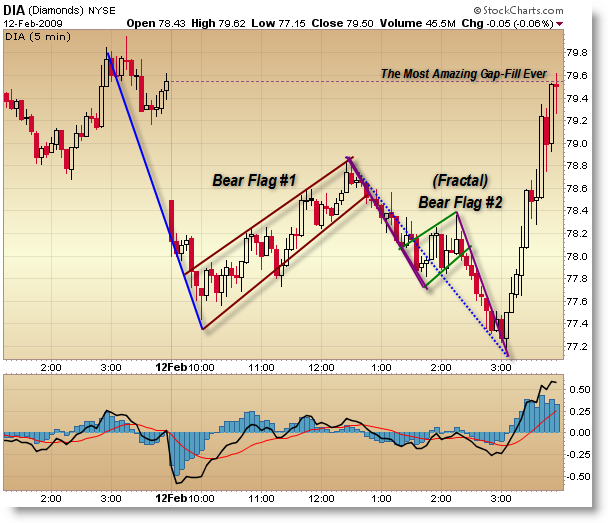
Bear Flags
My observation of a Bear flag is technically confirmed when you assess the following: A bear flag is consistent with an incisive, strong volume reduction on the basis of negative fundamental occurrence and then a number of sideways movements to a higher price with much weaker volume. This is preceded by a second sharp decline to new lows on solid volume.

Why Does It Happen?
Bear flags are a favored amongst proficient traders since they largely conduct large and self-assertive price movements. Similar to other continuation patterns, bear flags symbolize little more than a fleeting pause in a stronger move lower. The flag form basically forms in the middle of a critical move lower. As with Bull flags, Bear flags occur as stocks seldom move in one direction for any length of time. Instead the movement in cost is interrupted by concise periods of time where investors reassess their positions.

These moments in time are described as flags or pennants. The first section of the bear flag pattern is often described as a flagpole or mast. Throughout this period the stock price deteriorates and falls to a reaction low - usually after some negative fundamental occasion. Quite often this will be a downgrade in guidance, poor production reports or negative earning results. The reaction causes some panic and disappointment; the traders quickly show their dismay and unload their positions, the stock dives rapidly lower. Experienced traders familiar with the stock might have shorted it, other traders are long and as the price falls they have to cover their positions pushing the price even lower. Speculators buy the stock in the belief of a quick turn around, so there could be willing buyers but they usually lose money in these conditions.

It is at this stage the next phase or flag section unfolds. Due to the influx of data and the negative market opinion almost of the stock that was purchased by speculators is vigorously absorbed by nervous sellers but as it unfolds over time the selling pressure subsides and the stock slowly starts to rise with limited volume. The opportunists push the share price higher, although with diluted volume the rally fades and the stock reaches a short term top.

Amidst widespread bearish sentiment the stock charge deterioration threatens to direct the stock lower to new lows. As the losses start, the volume is weak and the share price is supported by bargain hunters. As a result, the prices stabilize and a second short term bottom is established. The second bottom is at somewhat higher levels.

Encouraged by the situation, the stock failed to make a new low. The speculators are preying on the stock and buying into the market. At this time the stock rallies just above but the volume is exhausted and the rally soon dissipates. Over the next few sessions the stock trades in a narrow range consolidating as volume declines hurriedly, before long the stock descends towards the established lows at.

During the next few sessions the stock breaks through the supporting low, this causes a breakout to the downside. A number of analysts report negatively to the market, usually about earnings over the next trading session and a new stage lower commences. The next trading session opens with further losses and the stock trades substantially lower in the coming weeks.

Technical signals
1. Sharp Move: for a continuation pattern to be considered, it requires supporting evidence of a prior trend. These flags necessitate a sharp advance or decline on strong volume. These movements can involve GAPS and are based on solid volume. Although this is generally the first leg of a key ascent or descent it is simply a pause.
2. Flagpole: The flagpole is the distance between the first resistance and the support break until the high or low of the flag. The intense advance or decline that forms the flagpole will generally break a trend line or support or else a resistance level. A line increasing up to the high of the flag creates the flagpole.
3. Flag: the flag is described by the small rectangle pattern that declines towards the previous trend. If the previous move was up then the flag would face down. If the move was down the flag would face up. As the flags are generally short in time, they usually have reaction highs and lows. The share price should be contained between two parallel trend lines.
4. Period: Flags are simply short term patterns and they largely last more or less 1 to 12 weeks.
5. Break: With a bearish flag, a break of the support level indicates that the previous falls have recommenced.
6. Volume: Volume need generally be solid throughout an advance or descent in which it forms a flagpole. The strong volume substantiates its position for a sharp and reactive move that forms the flagpole. The growing in volume at the sustain level provides the confidence in the constitution and the chances of the follow on.
7. Targets: the flagpole length can be determined by the endorse or resistor break of the flag to assess the advance or the decline.

Friday, July 2, 2010

The Cup and Handle in Foreign Exchange

Technically you have an extension of a bullish pattern; it marks a consolidation period then an accompanying breakout. The period cup and handle assumes nearby are two sections to the shape.

The cup evolves after an advance, it appears like a bowl, the cup is completed, and a trading pattern develops that has a limited range. With time the handle is formed. The ensuing breakout from the handle's trading range indicates an extension of the previous run higher.

Why Does It Happen?

Similar to the double top, the cup and handle develops usually with sentimental or popular stocks that have surged higher to a new high following positive market sensitive information. As the share price rises, the investor is contented in paying the higher market price but eventually the demand waivers and the stock price lingers lower, the experienced traders begin to lock in their profits. While the stock is supported by good fundamental prospects, the investors start to doubt the share price and its value. The share confirms a top and a sell off begin (top 1).

The share price suffers a large drop of up to 20 percent from its latest high. If this condition occurred during a bear market losses might stretch up to 50 percent. Opportunistic investors and speculators attempt to pick the undersurface and acquire into the stock, sooner than most. The share price steadies and a reaction low are established. Interest in the stock grows and the share price rises. It prevails a variety of attention from the media, gets on the radar of some analysts and shortly after the research analysts demonstrate positive ideas to the market. A new rally begins to evolve, market sentiment improves and buyers who have held the stock since the recent high are getting ready to close out their trades. They have been held out of the market because they didn't want to lose on a trade; again pride has something to do with not exiting the trade earlier. They are not persuaded into holding their positions upon hearing new bullish reviews; they just want to move on.

As the stock price overtures the old high at top 1, the traders who bought in at the first new high begin to deal rapidly, trying to protect their trading capital. A second top evolves which is well defined (top 2). This creates a significant U shaped pattern; as a result we have a CUP shaped pattern.

We now have a defining resistance high at top 1 and 2. The opportunists speculate the market and decide to short the stock. An interesting reflection from a proficient point of view of the pattern begins. There is a possibility that if stock prices fall dramatically and the volume of sellers increase, we could have a double top eventuate. But the volume subverts and the stock holders reign at this moment in time.

Shortly after the share price moves up convincingly on supporting news that the research houses release to the market. The stock price rallies to a new high as the short positions have to be covered along with new establish sureness; the inflow of positive news is overwhelming. This has created a small U shaped pullback and is commonly known and the handle in this pattern. Short positions that were not covered originally are now under pressure, the volume has increased on the positive news to the markets from the media and research houses and the share price is billowing. Over the coming weeks the stock now trades at considerably new highs.

Technical Signal

1. Trend: an established trend should be maintained in order to qualify as a continuation pattern. The trend should cover a number of months but not advance. The more mature the trend; the pattern will be misleading and not show any further potential.

2. Cup: the cup would preferably have a nice radius curve and resemble a bowl and have a rounded base. The smoother the bottom of the pattern the better the confirming support. The optimum pattern would have highs of equal support on both sides of the cup, although this is not always possible.

3. Cup Depth: Preferably, the retracement should be 1/3rd or lower than the recent high. In some situations where volatility is high, the retracement might be as much as 2/3rds. Generally in this extreme 2/3rds would be the utmost retracement.

4. Handle: following the second high, there is a nominal pullback that forms the handle. On occasions the handle gives the impression of a pennant or flag that falls away. Most handles are just a quick pullback. The handle portrays the final consolidation or pullback before a strong breakout rally to the upside. This can rally up to one third of the cup advance but generally never anymore. The smaller retracement, and the more aggressive the formation, the more important the breakout. It would be advisable at this stage to be cautious to wait for a break above the established resistance high of the cup.

5. Duration: the first phase being the cup shape could take up to six months to found, sometimes even longer on wider charts like weekly ones. The handle could acquire from one week to about one month.

6. Volume: volume generally should be significant once the stock price breaks over the resistance high or handle's immunity.

7. Target: a good estimate of the projected new stock price after the cup and handle is calculated by measuring the distance from the second top (top 2) to the base of the cup. You then add this frame to the breakout point which will be the mark.

The Foreign Exchange Descending Triangle

My observation of a descending triangle is confirmed whenever you assess the following:
An ascending right angle triangle pattern is a retrenchment to new lows following a reactive bounce to an intermediate resistance level, there is then another decline to test the recent low and then another rally towards the interim resistance then a final decline to a lower low on solid volume

Why does this occur?
I would like you to predict that a descending right angle triangle is the reverse of an ascending right angle triangle. Similarly the triangle evolves over time and subsequently a lengthy period of time. The descending triangle form forms after the stock suffers from a lot of information coming to the market that is not favorable, they could suffer profit warnings, poor media awareness, debt concerns, be downgraded from research houses, loss of key management/ personnel. Therefore the main concern about price weakness is unfavorable fundamentals.

Over a number of weeks, the stock trades lower with no support or low in the near future. Research houses report to the market their concerns and the stock hits a new low. Optimistic traders buy into the share and the majority of the interest comes from experienced long term investors (smart money). These investors are of the opinion the stock is at fair value.

The long term investors are in it for the long haul and are not concerned about short term issues but they are generally only eager to pay fair value for the stock. These investors are not keen to push the price higher to quickly. This buying creates the short term bottom (B1).

As the trade unfolds over the next few days, the professional traders begin to see the bottom and there are solid bids to buy at the B1 price. The recent sell off subdues as the emotion eases and the technical come into play. The stock moves higher on weak volume but with some possibly good reports to the market. The stock moves back up towards the price before its recent fall but fails on some more poor reports to the market. This creates a new reaction high. This causes the traders to sell protecting their capital. At this moment in time a pattern is beginning to unfold. The market again reports poor explore to the market and the stock falls forcefully and this time the selling is quite aggressive. The stock again falls back to the low at B1.

mostly with all the poor facts and limited confidence about the stock a rapid decline would usually eventuate but the long term investors hold their positions supporting the rate and the volumes begin to increase and defend is strong - this forms the second bottom (B2). Traders sitting on the sidelines begin to buy into the stock.

Speculators believe there is well established support and open up new positions, awaiting a strong bounce to the upside, the traders who have invested earlier ignore buying pressure and do not chase the stock higher, the share price moves higher but the volume weakens and the share price doesn't reach the recent reaction high, the price falls on the light volume.

In the next few trading days, the stock declines to the approximate low levels at B1 and B2. Opportunists double up adding new positions expectation a strong bounce in the share price. Unfortunately, the sell off continues and just as other long term buyers are about to enter the market negative sentiment hits the market, with this development the stock opens considerably lower and well below that of B1 and B2.

This decisive breakout to the downside, the longer term investors are instinctively revaluating their positions and long term strategies. With the inferior sentiment and negative ideas the sell off begins. A latest low is formed and over the coming weeks the stock trades at considerable lows.

The Course Prolongation - Ascending Triangle

My observation of an ascending right angle triangle is technically confirmed when you assess the following: This is where we have a rally to form a new high, this is then followed by a decline back down to the intermediate support level. We then have a second rally to retest the first new high. There is so a second decline but not falling as far as the former decline, this fall does not attain the intermediate hold level. We then break out to rally to new fresh highs on solid volume.

This structure generally takes place after a share has had a strong ascent to a new high usually because of some generally positive and fundamental expansion. Experienced investors are of the opinion that the share price should be higher under the new improved fundamental outlook. The traders who have bought earlier at lower prices are gearing up to sell off their positions, Applying fundamental metrics they usually set a share price at which they are happy to divest their investment and then just wait for the distribution process to unfold. In this situation fair value is not considered.

Generally the process of distribution unfolds after only one specific and bullish development. The share price rapidly advances to a new high. The research analysts and media begin sprouting buy recommendations and good news stories about the stock. The smart money seizes the opportunity to take their profits or liquidate their positions, (1st new high). It creates a minute top. The traders observe good supply at the new high. The share price begins to waver. Before long the price has fallen to its previous intermediate support level. This low is termed “reaction low” due to the way the shared price reacted to the recent new high. A few presume that an ascending right angle triangle is similar to double and triple tops, rising demand that's meets well established supply

Commonly, the implied basic information usable to traders is so robust, the traders simply ignore the weakness as profit taking, thus a new rally commences. The firm volume causes the share price to rise towards the previous high. As the share price hits the previous high it again is sold down (top 2). At this point some opportunists recognize a pattern or trend. They start to build short positions just below the recent high, usually this additional selling pressure would cause the stock price to fall rapidly but the positive reaction to the share is overwhelming. While the stock only slightly falls it does not reach the reaction lows that were set after the recent new time high.

After a short period of time - usually only days, positive revelations or developments occur and the share increases in price on very strong volume. The opportunists begin to add to their short positions but due to the experienced traders and investors who are buying into the stock, there is a limited amount of stock, this raising the share price.

At this point the share price breaks through the resistance level and then panic by the opportunists causes them to cover their short positions. These causes a synthetic ask for the stock at a time while the supply is quite low. Due to the bullish sentiment and underlying background, this leads to a stunning price increase on strong and solid volume.

Concisely after the breakout, the research analysts report to the market along with the media. This distorts the imbalance further and with high demand and low supply. The share price over the coming weeks rages higher to a new high. On this rare occasion the experienced traders are overwhelmed by the bullish opinion and it is at this point that the resistance level now becomes an important level of support.

The Several Technical Signals for Rising Wedge

1. Prior Trend. To be skilled to meet the criteria of a reversal design, there have to be a prior trend to reverse. The rising wedge generally forms over a 3-6 month period of time; this can qualify as an intermediate or long term reversal. At times the current trend is enclosed within the rising wedge. This design at other times will form after an extended share price advance.

2. Upper Resistance Line: It typically requires two response highs to define the upper resistance line although if likely three. The following reaction high should be higher than the preceding high.

3. Lower Support Line: It typically requires two reaction lows to define the lower resistance line but preferably three. The following response low should be higher than the preceding low.

4. Contraction: As the pattern unfolds the upper resistance line and the lower support line are converging towards each other. The positive advance from the response lows (the lower support line), become shorter in term. This makes the rally weak. This has the outcome of the upper resistance line not keeping pace with the lower resistance line, the two lines so converge indicating an over furnish of stock as the share price rises.

5. Support Break: the bearish confirmation of the pattern does not occur until after the support line is violated in an outstanding manner. It is usually practical to wait for a break of the previous reaction low but once support is breached, there is occasionally a reaction rally or bounce to test the newly found resistance level.

6. Volume: Ideally the volume will weaken as the share price rises, the wedge begins to evolve. The progress in volume at the support line break can be interpreted as a bearish indicator or its verification.